| Water Supply
The reservoirs of the Peak District National Park supply around 450 million litres of water a day to the many towns and cities that surround it. There are no natural lakes in the Park. Its has a relatively high average rainfall of 100 cm a year and shale valleys are very suitable for gathering water. Many valleys are dammed and flooded to create the reservoirs.
There are 55 reservoirs of over 2 hectares within the Peak District National Park. The largest area of reservoirs is in the Upper Derwent valley. Ladybower (shown in the distance in the photo below), Derwent and Howden reservoirs cover 340 hectares. Other important reservoirs are in the Goyt Valley and in Upper Longdendale.
The reservoirs attract tourists because there are proper walking and riding routes around them. They are normally surrounded by forests making them elegant and interesting places to visit.
Mineral Extraction
Mineral extraction is traditional and important to the local economy but leaves scars on the landscape and causes pollution and traffic congestion. Until the late 1800’s, lead was mined in the Peak District and provided income and employment for many local people. The old mining remains attract tourists and are of interest to archaeologists.
There are 10 main quarries and several mines within the Peak District National Park, most of which have been operating since before the National Park was formed.
Quarrying
Limestone
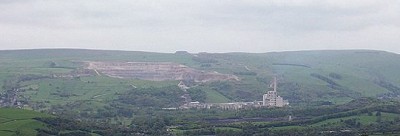
Limestone quarrying grew enormously in scale earlier this century and is now the biggest mineral industry. In 1999 4.7 million tonnes were quarried from within the Peak District National Park. The high quality limestone has a number of uses in the iron, steel and chemical industries. It is also used in agriculture, in cement making but most is now used for road stone.
Aggregates for roads, concrete etc 56%
Cement 23%
Other chemical uses 17%
Iron and Steel 4%
Agriculture 0.2%
Much of Derbyshire's limestone is very pure and is high in calcium carbonate. It can be argued that its use for road building is a waste of a valuable and rare asset. The largest quarries are Tunstead / Old Moor, Ballidon and Topley Pike.
Gritstone
Gritstone is quarried on Stanton Moor and at Stoke Hall, Grindleford. It is used mainly for building.
Fluorspar
Fluorspar was once thrown away as waste material by lead miners but it is now mined in the Peak District National Park for use in the manufacture of refrigerants, solvents, anaesthetics and toothpaste. In fact the majority of the fluorspar found in Britain is in the Peak District - especially the acid grade or high quality fluorspar (98%). This means that extraction is in the national interest.
Limestone is made up of lead ore, fluorspar, barytes and calcite. Fluorspar is now the most important of these minerals and about 70% of the UK production of fluorspar comes from within the Peak District National Park. It is extracted from lead mine spoil heaps or by underground or opencast mining. The main underground mine is Milldam Mine at Great Hucklow, with further underground mining on Longstone Edge and opencast mining on Bradwell moor.
In the Peak District they process about 400,000 tonnes of ore annually and also produce around 80,000 tonnes of acid grade high quality fluorspar.
Woodland
About 8% of the Peak District National Park is woodland. There are three different types of woodland:
· Conifer plantations in shale-grit valleys. These are often found around reservoirs.
· Small plantations on enclosed farmland, usually broad leaved or mixed.
· Semi-natural woodland on limestone dales, higher gritstone valleys and moorland fringes.
The Peak District National Park Authority manages 480 hectares of woodland and encourages others to manage woodland for wildlife and recreation. The Water Companies and Forest Enterprise, own large areas of coniferous woodland, mostly in water catchment areas.
Lots of animals live in woodlands. There are birds such as robins and grouse. You can also find animals such as mice, squirrels and toads.
Residential
As well as being a brilliant place to visit and admire, there are also many villages within the National Park, which have houses, schools and businesses. Some of the villages we passed through were Bamford, Hope, Hayfield and Mellor. They are very small compared to where we live, but have wonderful scenery around them.
|