|
B-29: The fifth "horseman" of the Apocalypse
By Scott Harrison
The B-29 Superfortress was the largest and most heavily armed bomber that was used during the Second World War. It was originally conceived as a more advanced replacement to the B-17 bomber which was brought into service in 1938, it was designed to be faster, to reach higher altitude and to be almost impervious to contemporary second world war anti-aircraft countermeasures as well as enemy fighters.
The B-29 Superfortress first flew in 1940 but wasn't ready for active service until late 1944. This wasn't surprising due to the fact it was one of the most advanced aircraft of its day. It featured a completely pressurised crew compartment, 5 remote controlled turrets and a sequenced bomb release mechanism which allowed it to maintain its centre of gravity during a bombing run. All in all it outpaced, outgunned or outmanoeuvred anything that came after it as well as being able to carry 20000Ib of ordnance. It's only disadvantage was its high development cost and it's difficulty to fly with problems with engine cooling and the cruise technique.
When the aircraft entered service in 1944 it was transferred to the pacific theatre where the American forces were engaged against the Japanese in a long running island hopping campaign. This conflict was fought over vast distances, between the pacific islands. Consequently until the introduction of the B-29 neither side was able to bomb their enemy's home territory. However, with the arrival of this aircraft the balance was shifted in favour of the USAAF (United States Army & Air Force). B-29s operating from the island bases of the Marina islands and mainland China started an intensive fire bombing campaign on major Japanese cities. There cities, mainly built of wood, were absolutely devastated by these attacks. A single raid on Tokyo on the night of 9th March 1945 cleared 15.5 square miles of the city and resulted in 84,000 casualties. The most people killed in a single raid ever. However, the most shocking development was yet to come. On the 6th of august 1945 a single unarmed aircraft piloted by Col Paul Tibbits dropped the Atomic Bomb on the city of Hiroshima. In an instant, this devastating weapon abruptly ended the lives of over thirty-thousand innocent lives. 6 days later a second bomb was dropped on the city of Nagasaki forcing the Japanese to surrender, ending the Second World War. The B-29 had just become the world's first Super weapon.
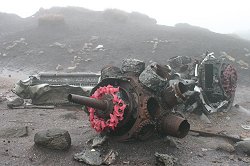 |
THE REMAINS OF AN ENGINE BLOCK |
| After the war in 1948 a squadron of B-29s was transferred to the UK to act as a nuclear deterrent to soviet Russia. This is where our Aircraft comes in. The B-29 'Overexposed' was being used to transport a cargo of mail and payslips to an American Airbase at Manchester Airport. Whilst on its approach to the runway, the aircraft descended too soon through the mist and impacted with the mountainside, approximately two Kliks north-east of doctors gate. |
|
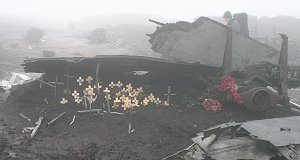
The aircraft had been carrying a full crew of 13 men, all of whom instantly died on impact. It is likely that they never saw the ground through the thick fog. The aircraft was destroyed and wreckage was strewn across the hillside. The site is eerily similar to that fateful day in 1949. All of the crew members were recovered and buried with military honours.
|
 |
|
A QUIET MOMENT
|
|
Why do so many planes crash in the dark peak area?
By David Brett
Having seen a plane crash sites and the areas of a few others, it really does help to
understand the navigational nightmare that the area presents to pilots. In this short
explanation, I aim to portray some of my personal feelings on why.
1. Contours and Gradients
The plane crash sites appeared to be near the summit of steep gradients. This suggests
that the pilots were unaware of the mountains until it was too late. This suggests
obvious pilot era but is it that hard not to see a mountain?
From personal experience, I can say that it is. When we were crossing many of the bogs
to get to Kinder Scout, we could not actually see it until we were in about a kilometre
of the final ascent.
The pilots would fly across the Pennines at low altitudes because they are heading to
Manchester Airport, which is just the other side. This meant that the planes suddenly
descended, and as the gradient suddenly changed for some aircraft, the manoeuvre
required for some craft is impossible, so it results in a crash.
2. Weather
During the whole of the first morning of our hike, it was very foggy with low cloud cover. If it was
apparently low for us, I would not be surprised that pilots crashed, as they would not
be able to see where they were going. They would not either be able to see any sudden
gradients and relying on a map and compass means that they could easily stray off course
and instead of
contouring a mountain, crashing straight into it. Then since much of the moorland would
indistinguishable, they would be unable to completely pin point there position
resulting in navigation error.
The reason behind the poor weather comes from the local geography. When the wind blows
across the sea it picks up moisture, then since the Pennines are the only mountain range
on that latitude in Britain the resulting sudden requirement for the moisture to lift
results in cloud formation and therefore poor visibility.
3. Navigation Error
Many of these crashes occurred many years ago before the creation of GPS where there was absolute reliance on land maps and compasses to guide a flight route. As the navigator was able to take compass readings and air speed readings they could work out there general position, though not as accurately as seeing definite places on the ground. This then means possible error which when flying high would have no effect. The fact that there is little altitude between the plane and the ground resulted in less tolerance to error. With a mile off course, it could be the difference between a peak and valley so the safety of the plane was not just in the hands of the pilots.
During our expedition we discovered the difficulty of navigating on contours and a compass this was difficult enough, a pilot on the other hand had no idea of contours so unfortunately this meant crashes were more likely.
In conclusion, to my ideas I feel the main problems facing the planes were the poor visibility and sudden changing gradients. Along with a must for low altitude flight, no wonder there has been many plane crashes in the area.
|

